The idea behind the Quota check is that the users are forced to stay under the disk consumption limit taking away their ability to consume unlimited disk space on a system.
Step 1) vi /etc/fstab
Partitions that you have not yet enabled quota normally look something like:
/dev/hda1 / ext2 defaults 1 1
/dev/hda2 /home ext2 defaults 1 1
To enable user quota support on a file system, add "usrquota" to the fourth field containing the word
/dev/hda1 / ext2 defaults 1 1
/dev/hda2 /home ext2 defaults,usrquota 1 1
Replace "usrquota" with "grpquota", should you need group quota support on a file system.
Step 2) Remount the File System to Enable Quota Support
# mount -o remount /home
Step 3)Initialize the new Quota Data Base
# quotacheck -c /home
Then a file named aquota.usr is created in the home directory
Step 4)Start the assigned quota by
#quotaon /home
To off the Quota--- #quotaoff /home
Step 5)The user policies can be implemented by editing the Quota File
#edquota -u username
/dev/hda3: blocks in use: 2594, limits (soft = 5000, hard = 6500)
inodes in use: 356, limits (soft = 1000, hard = 1500)
Block in use-Used Space
Soft-Get Warning(The size reaches a particular point it shows warning)
Hard-Maximum Limit(Quota Exceeding Size)
inode-No of Files
For Checking the status of user Quota
# repquota −a
For Checking the Quota
Step 1)Switch to that user
# su - username
Step2)Create files in this home directory
#dd if=/dev/zero of=filename bs=1024 count=50
{Here 50 Kb is allocated to that directory...By giving more size you can check this}
Tags:-Quota ,Quota check in Linux,Quota users,how to do quota in Linux,How to Check Quota in Linux,Quota Commands,Quota commands in Linux,Quota informations in Linux,Methods to do Quota,Methods to do Quota in Linux,Steps to do Quota Check in Linux
Showing posts with label Seminar Topics. Show all posts
Showing posts with label Seminar Topics. Show all posts
Thursday, August 27, 2009
Monday, August 24, 2009
How to Create UBUNTU Bootable USB/Pendrive from Windows
Minimum Requirements:
- Above 1GB USB.Flash Drive
- Ubuntu ISO
- CD Burner/Recorder
- 7-zip (or another ISO extracting tool)
Steps:
Partition and make the USB flash drive bootable:
- Download the Ubuntu 6.10 ISO and burn it to CD
- Restart your computer (booting from the Ubuntu Live CD)
- Insert a 1GB or larger USB flash drive
- Open a terminal window and type sudo su
- Now type fdisk -l to list available drives/partitions (note which device is your flash drive Example: /dev/sdb). Throughout this tutorial, replace all instances of x with your flash drive letter. For example, if your flash drive is sdb, replace x with b.
- Type umount /dev/sdx1
- Type fdisk /dev/sdx
- type p to show the existing partition and d to delete it
- type p again to show any remaining partitions (if partitions exist, repeat the previous step)
- type n to make a new partition
- type p for primary partition
- type 1 to make this the first partition
- hit enter to use the default 1st cylinder
- type +750M to set the partition size
- type a to make this partition active
- type 1 to select partition 1
- type t to change the partition filesystem
- type 6 to select the fat16 file system
- type n to make another new partition
- type p for primary partition
- type 2 to make this the second partition
- hit enter to use the default cylinder
- hit enter again to use the default last cylinder
- type w to write the new partition table
- Type umount /dev/sdx1 to unmount the partition
- Type mkfs.vfat -F 16 -n usb /dev/sdx1 to format the first partition
"Alternately you can try mkfs.vfat -F 32 -n usb /dev/sdx1 (doesn't always work)"
- Type umount /dev/sdx2 to ensure the partition is unmounted
- Type mkfs.ext2 -b 4096 -L casper-rw /dev/sdx2 to format the second partition
- Remove and Re-insert your flash drive
- Back at the terminal, type sudo apt-get install syslinux mtools
- Type syslinux -sf /dev/sdx1
- Restart your computer, remove the CD and boot back into Windows
Using Windows to prepare and move the files to the USB Stick:
- Create a folder named USB on your computer
- Download UBconvert.zip and extract the files to the USB folder
- Move the Ubuntu 6.10 ISO downloaded earlier to the USB folder
- Click fixu.bat from the USB folder (follow on screen instructions)
- Move all files from the ubuntu directory to your memory stick
- Reboot your computer and set your system BIOS to boot from USB-HDD or USB-ZIP. Also set the "Hard Disk Boot Priority" if necessary.
You should now be booting into Ubuntu Linux from your USB drive!
Tags:-USB Bootable,install ubuntu through USB,How to make Ubutntu bootable from a USB,Ubuntu bootable from USBor Flash Drives
Wednesday, August 5, 2009
Nissan LEAF - The World's First Affordable Electric Car?

Nissan Motor Co., Ltd. Sunday, (Aug. 2, 2009) unveiled the world's first affordable, zero-emission car - the Nissan LEAF. Nissan LEAF is a medium-size hatchback able to comfortably seat five adults with a range in excess of 160km (100 miles). The chassis has been designed specifically to be lithium-ion battery-powered.
Nissan Leaf, will be available in Japan, Europe, and the United States in the second half of 2010. The car can be summarised as being part of Nissan's radical, transformative vision for the future, and also the result of decades of investment and research.
Nissan President and CEO Carlos Ghosn has described Nissan LEAF as a 'tremendous accomplishment in which all of the company's employees can take pride'. He said the company has been working tirelessly to make possible a day when a zero-emission car - not just reduced emissions - will be possible, and said this is the first step on an exciting journey for both Nissan as a company and also the entire industry as a whole.
The most notable characteristic of the car is of course its zero emission platform and power train. In addition it also has an affordable price range, and boasts Connected Mobility: Advanced intelligent transportation (IT) system. Pricing details are not yet available, but will be released near the commencement of sales in late 2010. It is expected though that the car will be in the range of a well-equipped C-segment vehicle.
It is no coincidence that the car has been named LEAF, as this name has a direct connotation to how leaves in nature also purify air. Nissan LEAF purifies mobility, by removing emissions from the driving experience.
Nissan LEAF is expected to qualify for various significant local, regional and national tax benefits and incentives in world markets. Of course the added benefit is that Nissan LEAF has much less mechanical parts and complexity, which should make maintenance user, and pocket, friendly.
Tags:-Nissan,Nissan Learf cars,Nissan new technology,Nissan News,Nissan2010 releases,Nissan latest news,Nissan New Cars
Friday, July 31, 2009
Performance Analyzer
Performance Analyzer is the web application which helps managers in an organization to evaluate the performance of their staff. Performance Evaluation increases the productivity of the organization. Used constructively, this program of performance evaluation can prove to be a valuable tool regarding individual career advancement, and result in increased productivity throughout all areas of this organization. This application is to provide staff, managers and administrators, a fast, interactive and effective way to conduct and administer appraisals. This can be done anytime and anywhere via Intranet or Internet. It helps to reduce manual task of individually appraising each staff, therefore allowing managers/staff to focus more on other core duties.
With PA your organization will become effective, more focused on achieving its goals, rewarding its employees and encouraging their progress and development. Evaluation summary is an overall rating and should include other employees’ comments also.
This project has the following modules
- Administrator Module
- Manager Module
- Employee Module
- Performance Appraisal
Tuesday, July 28, 2009
The ORB™ Bluetooth Headset - Sci-fi Becoming Reality?

Well, it was only a matter of time before this new gadget would make its way into the mainstream, and dare we say - we think the concept is a real winner.
With electronic gadgets getting smaller and smaller, giving a user even more freedom with regards to portability and mobility, the ORB™ is a nifty little gadget we think will most likely set the standard for most future bluetooth and portable listening devices.
First we had the fixed line telephone, then came the next logical step - the wireless (or cellular) phone, giving the user mobility. Having said that, the portable phone would still need to be carried around - and could sometimes be considered a lumpy little device that you need to be aware of constantly, in order not to lose it, or forget it on the table of your favorite coffee shop as you gracefully exit.
Now considering the evolution of the telephone over the last years from fixed line to wireless, from bulky to light and compact, one could almost guess the next logical step, right? Well how about having your phone on your ear, almost out of sight completely.
Well, admittedly we're not completely at that stage yet, but my gut feeling is we're probably moving ever so purposefully in that direction. At least, the inventors and manufacturers may be considering it as a next step in the evolution of the phone. Probably also the final step in evolution, because let's face it - where would one go from there? Telepathy maybe? :) But consider a little device so unobtrusive, light and compact, able to fit snugly onto your ear without being unsightly, or visually distracting to everyone you may come into contact with?
Introdcing the "ORB™ Wireless Earpiece Finger Ring" - that's a mouthful for such a small device. On July 23rd, 2009, AbsolutelyNew Inc, announced that cellphone users worldwide - which incidently now exceeds more than 1 billion - may soon be able to look forward to this new device. Now besides being able to fit snugly into a person's ear - the little device actually transforms from a finger-worn ring, that twists open, to become a secure, comfortable and sophisticated Bluetooth headset. Yes, you read correctly - it transforms from a finger ring into a bluetooth headset, with a simple twist - and voila! - you're talking to your friends in no time.
The technology was developed by Hybra Advance Technology Inc, and AbsolutelyNew's Science+Technology Division. Now, the device uses "bone conducting technology" that delivers high quality sound - without the device actually being inside the ear.
The deluxe version features a FOLED, short for "Flexible Organic Light Emitting Diode" screen, which gives access to caller ID and also calender reminders. Another feature is voice-to-text, without the need to even take the ring off one's finger. The not-so deluxe model, or "base model" as it is called, features no screen or display. However, all models have a 30 foot range, which is "class 2 Bluetooth", and are available in different ring sizes.
The ORB™ is set to become available on the market in the USA, Asia and Europe in January 2010. The suggested retail price for the base model is $129 USD, featuring an aluminum housing, while the deluxe version (featuring the displays) will become available in April 2010 - suggested retail price: $175 USD
Limited edition models are also planned, featuring gemstones.
AbsolutelyNew is a company that specializes in partnering with inventors, manufacturers, and retailers alike, to launch new breakthrough products onto the market.
Court Automation System
The project entitled Court Automation System provides the means of automating the complete dealings of a court, hence making the system much more efficient by computerizing the Registration of cases, proceedings of cases, Judgements and all other activities in a court.
Nowadays, the cases are handled manually with the help of various official documents including registered. The main aim of the project “Court Automation System” is to .For convenience, errorless and paper free of the user.
It has six modules:
- Admin Module.
- User Management Module.
- Case Module.
- Verdict/Punishment Module.
- Financial Module.
- Report Module.
The home page introduces the system and we have to login to the system. The home page is the first look the visitors see about the system and is often the determining factor as to whether a visitor stays or leaves. All the major categories of search are listed in the home page. When the user clicks any of these links, a JSP will run which searches for the entire subcategories under the clicked category and list all of them in a single page. When again click any of these subcategories another JSP will run which search for the site name description and list in a single page. Development of a theme is the most important element of a strong home page.
Tags:-MCA project topics,B-tech Project topics,MCA project topics synopsis,MCA project topics abstract,MCA project topics modules,BCA Project topics,BCA project,BCA Project topics Abstract,Engineering Projects,Engineering Academic projects,Project informations,Projects based on Java,Projects based on Struts
Monday, July 13, 2009
Scientists Create New Wonder Material 1 Atom Thick - Stronger Than Diamond
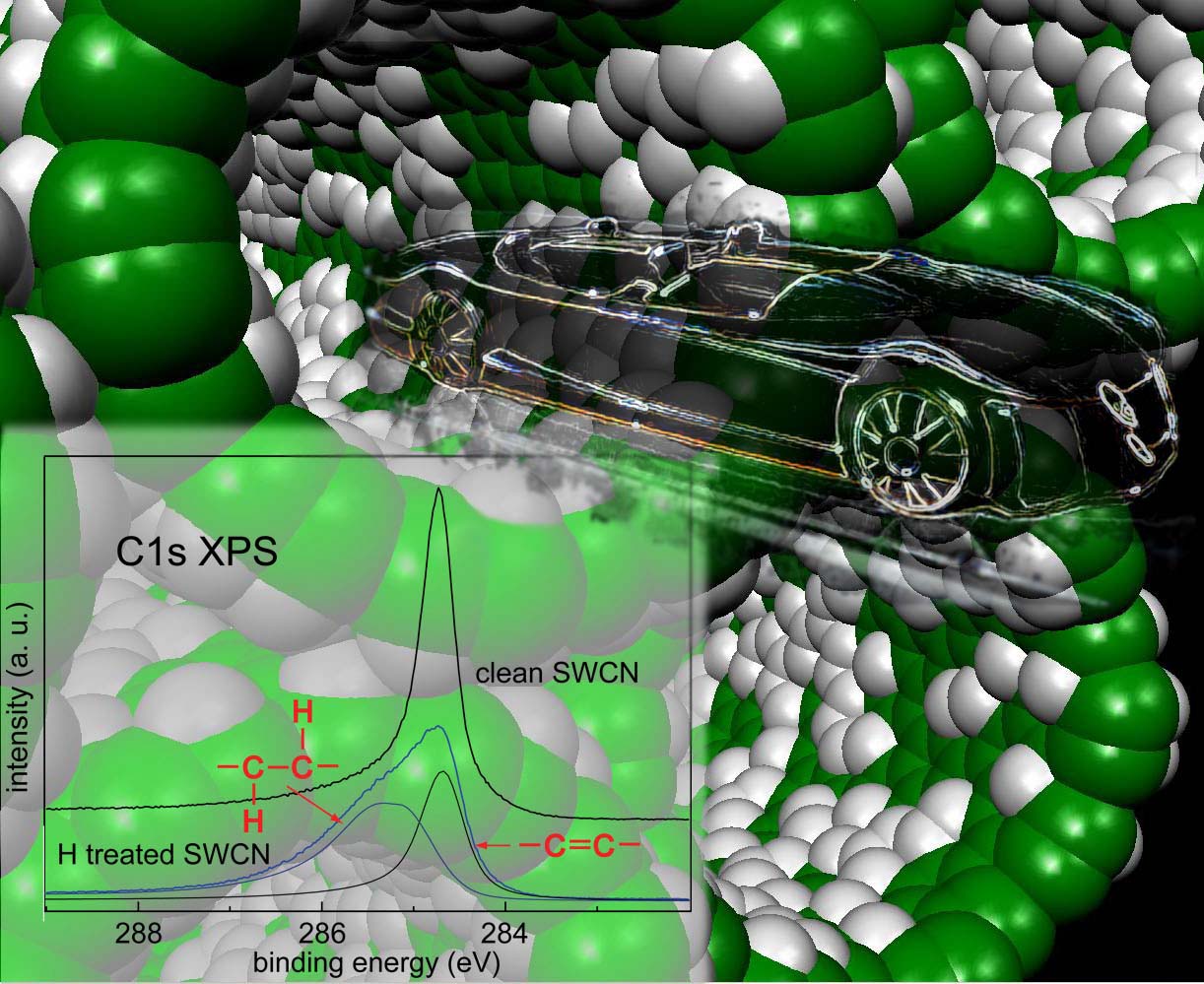
It sounds like something from a futuristic science fiction film, but scientists have created a new 'wonder material' that has much of the scientific world astir.
Imagine this: a sheet about the size of a football field - but weighing only a few grams in total. Yes, a few grams. Now imagine that the sheet is only one atom thick, yet it is stronger than diamonds.
Now it does indeed start to sound like something from a science fiction movie. There is one more attribute to this material that we have no yet mentioned - it has the ability to conduct electricity approximately 100 times faster than current silicon chips used in computers. Yes, 100 times faster.
So let's recap - the thinnest known material in the universe, stronger than any diamond, able to conduct electricity at super fast speeds, weighing almost nothing. That is what this material is. So what is this new material that has the entire scientific world abuzz?
Called 'Graphene', the material was first discovered in 2004, but new research being done in recent months could open up a whole new world of applications for the material. Currently, quite a bit of research is being done to determine the eficiency of this technology in computers and other electronic devices. This would mean that microchips would be able to operate at much higher speeds than today's standard silicon chips.
In order to make electronic devices faster, the frequency it needs to work at, needs be higher in order for it to be faster. Currently, scientists find it difficult to generate frequencies above 4 or 5 gigahertz. This new wonder material called Graphene will make ranges of 500 to 1000 gigahertz possible.
Although the technology is still in the early stages of development, it is believed that it may become a commercially viable product within two years.
It seems this technology is set to become part of electronic and other devices, one could possibly even say that the technology may transform these devices in future. Either way, it is an exciting developement that has the whole scientific world stirring and buzzing, and we will definitely be keeping an eye on this technology in future.
Sunday, July 5, 2009
Change MAC address in Windows
Although MAC (Memory Address Control) addresses are meant to be permanent, it is possible to change the MAC address reported in the operating system. Changing of a MAC address is sometimes necessary for maintaining privacy when connecting toWI-Fi and for interoperability, and the act is sometimes called “spoofing”.
An Internet Service
In Windows, the MAC address can be changed in the property menu of the Ethernet adaptor. The exact name found on the “Advanced” tab depends on the Ethernet driver used and a user may find various names such as “Ethernet Address”, “MAC Address”, “
The adaptor can be reset by using acommand line utility offered for free by Microsoft called Devcon. The addresses of all cards, including those that are not changed through the property menu of the adaptor can be changed with the SMAC MAC Address Changer. The new address can be checked by clicking on Run from the Start menu and entering the command module (cmd) followed by typing ‘ipconfig/all’ into the command prompt, which shows the MAC address under the physical address.
All routers do not have the facilities to change the MAC address and the mode of changing varies greatly in those that so. The “clone MAC address” feature in a router helps change the MAC address by obtaining the MAC address of one of the machines present in the network and replacing the current address of the router with the acquired one. Some routers also allow the MAC address to be changed manually.
Using a MAC address as the sole method of identification is not a very good idea seeing that MAC addresses can be altered. Another method, the IEEE 802.1x can be used instead as it is coming up as a standard authentication method for low-level devices.
Bluetooth-Open Wireless Technology

Bluetooth is an open wireless technology based on wireless-based open protocol that is used to connect Bluetooth enabled electronic devices. This allows quick and easy synchronization and data transfer.
Bluetooth offers worldwide compatibility as the Bluetooth radio chip, which is built into a small microchip, functions in a globally available frequency band. There is no cabling involved and files, photos and other information are easily exchanged between the connected electronic devices. The connected devices, which may include cellular phones, laptops, personal computers, printers, digital cameras, GPS receivers and even gaming consoles, communicate and exchange data through a secure 2.4GHz to 2.485GHz short range radio frequency bandwidth. Users can, therefore, create Personal Area Netwoks, or PANs for connecting with other Bluetooth compatible devices.
Bluetooth was designed keeping in mind the requirement to operate and allow sharing of data and information exchange in noisy environments where there may be interference from other radio frequency signals such as those from microwave ovens. The radio technology made use of is named frequency-hopping spread spectrum. This technology makes the link between the connected devices a very robust one.
Bluetooth 3.0 General Specifications
Tags:-Bluetooth,Bluetooth features,What is a bluetooth,Bluetooth design,Bluetooth version
Friday, June 19, 2009
Researchers Detect First Real Evidence Of Lightning On Mars

University of Michigan researchers say direct evidence of lightning has been detected on Mars for the first time ever
Researchers believe that electric activity in the Martian atmosphere, even from dust storms, carries with it important scientific implications for the red planet.
As one may imagine, these events will have an effect on atmospheric chemistry, and also for future manned exploration of the planet.
An innovative microwave detector developed at the U-M Space Physics Research Laboratory, was responsible for the discovery. Capable of differentiating between thermal and non-thermal radiation, the Kurtosis detector took microwave emission measurements from Mars for approximately five hours a day, over a 12 day period. The measurements were taken between May 22 and June 16, 2006.
The findings are based on an unusual pattern where non-thermal radiation, combined with an intense Martian dust storm occurred. It was during this time only that non-thermal radiation was detected. From a scientific point of view, non-thermal radiation would suggest the presence of lightning, and this new evidence is also in line with findings regarding soil measurements from the Viking landers, 30 years ago.
Mars is the fourth planet from the sun in our solar system, and is often referred to as the 'red planet', because of its reddish appearance caused by iron oxide on Mars's surface.
As far as exploration goes, the Mars surface is also home to two Mars Exploration Rovers namely 'Spirit' and 'Opportunity', as well a three functional orbiting spacecraft - these are: Mars Odyssey, Mars Express, and the Mars Reconnaissance Orbiter.
Mars is about half the size of earth, and in addition, Mars also has two moons, Phobos and Deimos, which are small and odd shaped. Exploration and research of Mars is ongoing.
Friday, June 12, 2009
Deep-Sea Robotic Veichles Drives to New Record Deapth

Pilots operate the unmanned Nereus remotely from a surface ship, using an extremely thin, fiber-optic line that allows the vehicle to dive to these incredible depths, while remaining highly maneuverable. The Nereus also has the ability to be switched to an autonomous, free-moving vehicle.
As you may imagine, diving to these kinds of depths pose a significant number of challenges, most of all from water pressure. Imagine having the weight of 10 kilometers of water above you. Imagine tying to pick up a wine barrel standing about 1 meter high filled with water... That in itself may be an almost impossible task for most people. Now imagine that 10,000 over. Incredible water pressure - reportedly more than 1000 times the standard atmospheric pressure measured at sea level.
The Mariana Trench is currently known to be the deepest part of the ocean. Project manager and principal developer of Nereus at the Woods Hole Oceanographic Institution (WHOI), Andy Bowen, believes that a vehicle like this will enable research to be carried out on just about any part of the world's oceans. Bowen believes that this vehicle marks the start of a new era of ocean exploration and research. Until now, underwater vessels were only able to explore up to about 6,500 meters (4 miles) below the oceans. The Nereus project reportedly cost in the region of about 8 million dollars to develop, and was sponsored mainly by the National Science Foundation (NSF) Ocean Sciences Division.
The Mariana Trench is part of the Pacific Ring of Fire, a 40,000 kilometer (25,000 mile) area in the western North Pacific Ocean, to the east and south of the Mariana Islands, near Guam. the area is known as place where most of the earth's volcanic eruptions and earthquakes occur.
As you may imagine, diving to these kinds of depths pose a significant number of challenges, most of all from water pressure. Imagine having the weight of 10 kilometers of water above you. Imagine tying to pick up a wine barrel standing about 1 meter high filled with water... That in itself may be an almost impossible task for most people. Now imagine that 10,000 over. Incredible water pressure - reportedly more than 1000 times the standard atmospheric pressure measured at sea level.
The Mariana Trench is currently known to be the deepest part of the ocean. Project manager and principal developer of Nereus at the Woods Hole Oceanographic Institution (WHOI), Andy Bowen, believes that a vehicle like this will enable research to be carried out on just about any part of the world's oceans. Bowen believes that this vehicle marks the start of a new era of ocean exploration and research. Until now, underwater vessels were only able to explore up to about 6,500 meters (4 miles) below the oceans. The Nereus project reportedly cost in the region of about 8 million dollars to develop, and was sponsored mainly by the National Science Foundation (NSF) Ocean Sciences Division.
The Mariana Trench is part of the Pacific Ring of Fire, a 40,000 kilometer (25,000 mile) area in the western North Pacific Ocean, to the east and south of the Mariana Islands, near Guam. the area is known as place where most of the earth's volcanic eruptions and earthquakes occur.
Tags:-Robotic veichles,See Robotics,Robot Application,Seminar topics,Seminar,Deep-Sea Robotic Veichles features,Deep-Sea Robotic Veichles records,Deep-Sea Robotic Veichles
